
Introduction: From Product to “Aesthetic”
In the world of retail, the standalone product is dying. Today’s consumer, influenced by Instagram and Pinterest, is shopping for an aesthetic. They don’t just want a Challah cover; they want a tablescape. They don’t just want a Kippah; they want a look.
For Judaica retailers, this presents a massive opportunity for Cross-Selling.
If a customer is buying a velvet Kippah for their husband, they are the prime candidate for a matching Tallit Bag. If they are buying a Challah cover for a new home, they need matching Kippot for their guests.
The challenge? Finding these items that actually match. Buying a Navy bag from Vendor A and a Navy Kippah from Vendor B usually results in a mismatch. As a vertical manufacturer, Xindi Knitwear solves this by producing coordinated collections from the exact same fabric rolls.
1. The “Groom’s Suite”: The High-Ticket Wedding Item
The engagement period is peak spending time. The bride buys the groom a Tallit bag; the groom buys Kippot for the wedding party.
The Factory Solution: The “Dye-Lot Guarantee” Nothing looks worse in wedding photos than “clashing navies.”
Unified Production: We cut the Groom’s Tallit Bag, the Tefillin Bag, and the Wedding Kippot from the same roll of velvet.
Embroidery Continuity: We use the exact same gold thread and digitization file for the monogram on the bag as we do for the crest on the Kippot.
Retail Strategy: Offer a “Groom’s Bundle.” Instead of selling items individually, package them as a “Complete Wedding Suite” for a 20% premium.
2. The Shabbat Table Collection: Interior Design for Fridays
The modern Jewish home is styled. The Shabbat table is the centerpiece.
The Trend: Linen & Raw Silk We are seeing a surge in demand for natural fabrics.
The Product Mix:
Challah Cover: Heavyweight Linen with embroidery.
Kippot: Matching Linen Kippot for the host and guests.
Afikoman Bag (Seasonal): Coordinating piece for Passover.
Design Cohesion: If the Challah cover features a “Pomegranate” motif, we embroider a miniature version of that same pomegranate on the rim of the matching Kippot. This attention to detail turns a $30 sale into a $200 set.
3. Manufacturing Capabilities: Beyond the Dome
Many retailers don’t realize that a Kippah factory can produce flat goods.
Tallit Bags: We utilize our heavy-duty sewing machines (used for leather rims) to construct durable, fully lined velvet and leather Tallit bags.
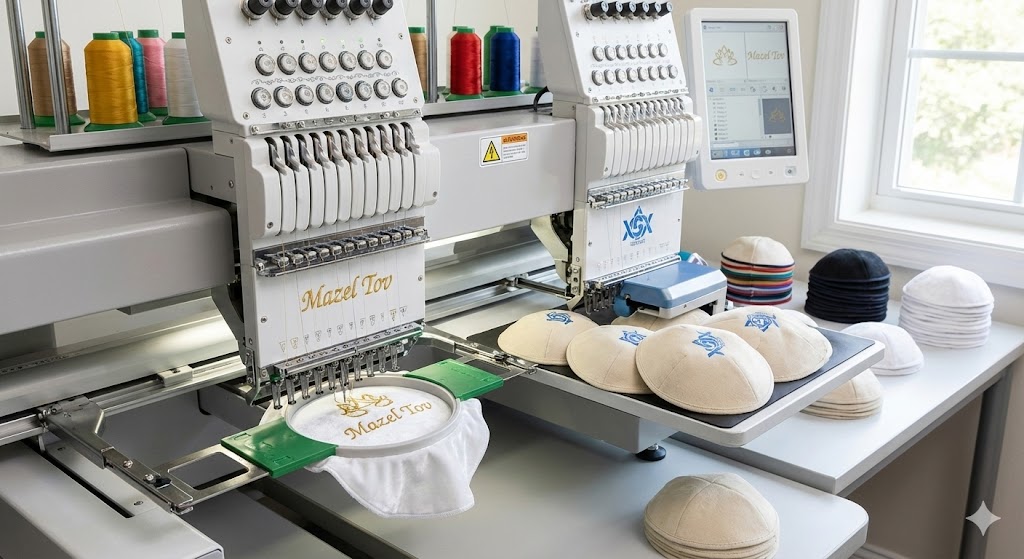
Challah Covers: Our embroidery machines have a wide field (area), allowing us to stitch large, complex designs required for full-size Challah covers.
One Supplier, One Invoice: By consolidating these categories with us, you simplify your supply chain and guarantee consistency.
4. The “Bar Mitzvah Gift” Box
The most common question in Judaica shops: “What do I get for a Bar Mitzvah boy?”
The Pre-Packaged Solution: Create a “Coming of Age” box.
Contents: A personalized Tallit Bag, a matching Tefillin Bag, and a set of 4 matching Kippot (one for Shabbat, three for daily school wear).
Customization: We can produce these “blanks” in bulk (e.g., solid Navy Velvet) and you can offer on-site monogramming of the boy’s initials in your shop.
Conclusion: Stop Selling Pieces, Start Selling Sets
When you stock mismatched items from five different vendors, you force your customer to do the work of matching them. Often, they give up.
By curating Coordinated Collections directly from the factory, you make the buying decision easy. You provide a level of polish and sophistication that big-box online retailers can’t replicate.
Curate your collection. Ask for our “Sets & Suites” catalog to see our pre-matched fabric families.