
Introduction: When Less is More
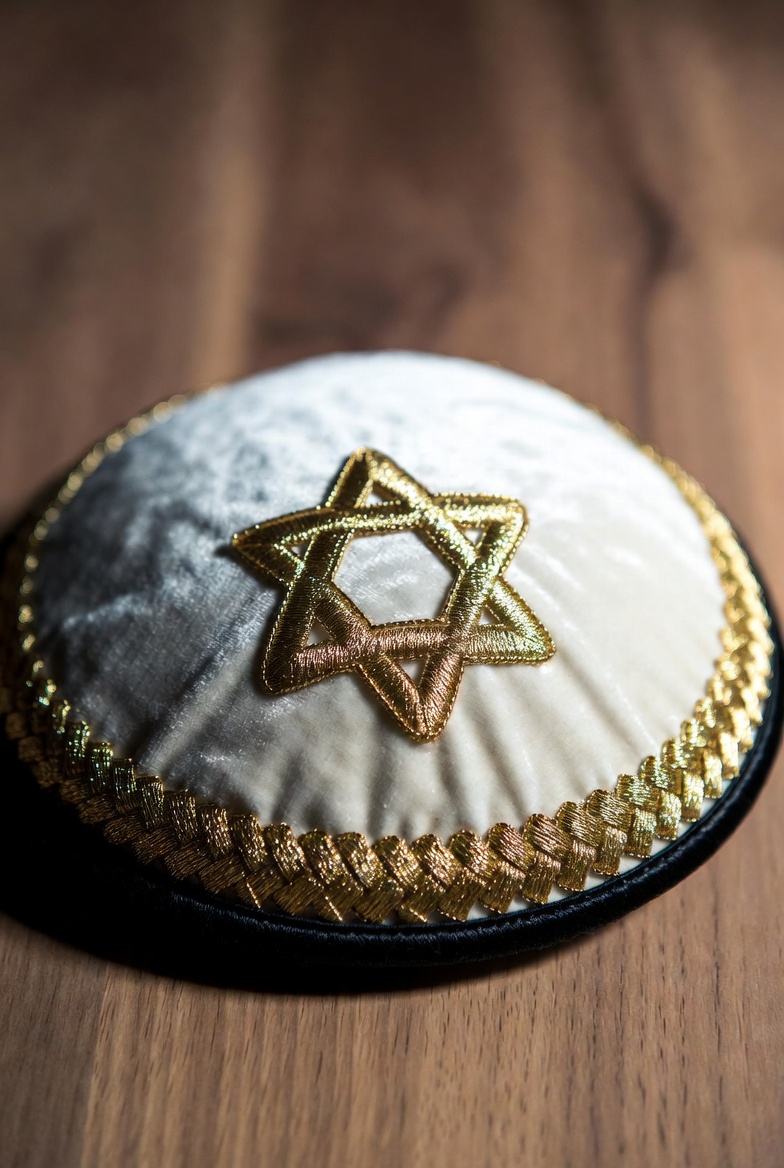
For a long time, the Kippah market was defined by “pop”—bright colors, contrasting rims, and loud patterns meant to stand out.
But enter 2026, and the mood has shifted. Influenced by the global fashion trend of “Quiet Luxury” and Scandinavian minimalism, the modern Jewish consumer is seeking headwear that whispers rather than shouts.
For B2B retailers, this “Minimalist Wave” is a critical pivot point. The customer isn’t looking for plain (which implies cheap); they are looking for refined. As a manufacturer, we achieve this look through precise color matching and premium textures. Here is how to master the monochromatic trend.
1. The “Tone-on-Tone” Technique
The hallmark of this trend is the Monochromatic Palette. This means the base fabric, the rim binding, and the embroidery are all shades of the same color.
The Factory Challenge: Achieving a perfect “Navy on Navy” is harder than it looks. If the rim is slightly purple-navy and the dome is slightly green-navy, the product looks cheap.
-
Our Solution: We dye our own binding tapes to match the specific dye lot of the base fabric.
-
The Result: A seamless, cohesive look. A Charcoal Grey suede Kippah with Charcoal Grey stitching and a Charcoal Grey rim looks architectural and expensive.
2. Texture is the New Pattern
When you remove color contrast, Texture becomes the design.
For Knitwear (Srugim): Instead of multi-colored geometric patterns, we are using complex stitch structures in a single color.
-
The “Waffle” Knit: A raised, grid-like texture created in solid white or grey. It catches the light differently, creating visual depth without using a single drop of colored dye.
-
The “Heathered” Yarn: Using twisted yarns (Mélange) that combine two shades of grey or beige. It gives the appearance of stone or wool felt, adding a rich, organic feel.
3. The “Seamless” Profile
Minimalism is about removing unnecessary lines. The traditional “rim” (the binding strip sewn on the edge) is often seen as visual clutter by modern designers.
Manufacturing Innovation: The Self-Finish Edge
-
Knit: We use Integral Knitting machines that finish the edge of the Kippah during the knitting process. There is no added rim, just a clean, continuous line of fabric.
-
Leather/Suede: We use a “Turned Edge” technique (similar to high-end wallet manufacturing) where the leather is thinned (skived), folded over, and glued/stitched invisibly. This creates a razor-sharp, modern silhouette.
4. The Branding Paradox: Hidden Logos
In the era of minimalism, customers don’t want to be walking billboards.
The “Ghost” Embroidery: If a school or organization wants branding, we recommend “Ghost Stitching”—embroidering the logo in the exact same color as the Kippah (e.g., Black thread on Black velvet).
-
The Effect: The logo is only visible when the light hits it at a certain angle. It is subtle, sophisticated, and highly requested by high-end law firms and corporate donors.
5. Merchandising the “Capsule Wardrobe”
This trend allows retailers to sell “Packs” rather than singles. The minimalist customer thinks in terms of a “Uniform.”
The “Architect’s Pack”: Curate a box of 4 monochromatic knits:
-
Slate Grey
-
Midnight Navy
-
Oatmeal
-
Matte Black
-
Why it sells: It solves the daily dressing problem for the professional man. It guarantees that whatever suit he wears, he has a Kippah that matches perfectly.
Conclusion: Silence Sells
In a noisy world, silence stands out. The shift towards minimalist Kippot is not a passing fad; it is a maturation of the Judaica market.
By stocking Monochromatic, Textured, and Seamless styles, you attract a demographic that values design, quality, and sophistication.
Simplify your supply chain. Browse our “Minimalist Series” catalog to see our new textured solids and heathered knits.